
Tune details
Music: Cole Porter
Words: Cole Porter
Published / composed: 1932
Original key: Not established
Study level: Intermediate to advanced; long form
 Djangopedia
An insistent melody and a dark approach to a major tonic create a distinctive tension. The 48-bar chorus asks players to hear a larger structure than the familiar AABA template.
Keep the complete 48-bar architecture in your ear.
Owner content reviewed — 2026-10-04T23:09:04Z by admin. Coverage measures presence, not accuracy. Content review does not certify rights or musical perfection.
Django recordings for this tune. Uploader dates and take labels remain source claims; only an evidenced exact association enables a row’s Listen control.
Uploader identifies this as Django Reinhardt’s performance; recording date and take require comparison with the discography.
| Entry | Year | Recording / session / release evidence | Listen |
|---|---|---|---|
| 01 | 1938 | Night and Day,31/1/38,DTB 3525-1 ,"Fremeaux 307, JSP 342, Classics 777, Music Memoria 87948, Jazz Archives 157222, Conifer HD 165, Rhapsody RHCD6"," - London - QHCF - Stephane Grappelly (v), Django Reinhardt, Roger Chaput, Eugene Vees (g), Louis Vola (b)" | — |
| 02 | 1947 | Night And Day, 10/12/47, ST 2220-3 ,"Fremeaux FA 316, Verve 835 418-2"," - Paris - Rex Stewart (tpt), Hubert Rostaing (as), Django Reinhardt (g) Ladislas Czabanyck (b), Ted Curry (d)" | — |
| 03 | 1949 | Night and Day, Jan-Feb 1949, CW 19,"Fremeaux FA 316, Jazz Time 789103-2"," - Rome - Django Reinhardt (g), Stephane Grappelly (v),Gianni Safred (p), Carlo Pecori (b), Aurelio de Carolis (d)" | — |
| 04 | 1949 | Night and Day, 1949,"Fremeaux FA 318, Vogue 228E 6010", - Paris - Paul Baron and his Orchestra featuring Django Reinhardt (g) | — |
| 05 | 1953 | Night and Day, 10/3/53, "Verve 835418-2, Verve 516 931-2"," - Paris - Django Reinhardt (elg), Maurice Vander (p), Pierre Michelot(b), Jean-Louis Viale (d)" | — |
A dash means no video has been associated with this exact historical recording. Tune-level listening resources remain available above.
Cole Porter wrote Night and Day for Gay Divorce in 1932. Djangopedia lists Django’s London recording of 31 January 1938 and several later entries. The inherited chart is in D. A backing video labelled for C instruments means concert-pitch notation; that label alone does not establish the tonic key.
Music: Cole Porter
Words: Cole Porter
Published / composed: 1932
Original key: Not established
Study level: Intermediate to advanced; long form
Listening task: Keep repeated notes alive through timing and dynamics. Count the head before comparing solo choruses.
Night and Day,31/1/38,DTB 3525-1 ,"Fremeaux 307, JSP 342, Classics 777, Music Memoria 87948, Jazz Archives 157222, Conifer HD 165, Rhapsody RHCD6"," - London - QHCF - Stephane Grappelly (v), Django Reinhardt, Roger Chaput, Eugene Vees (g), Louis Vola (b)"
Compare the tempo, key, introduction and final cadence with the first entry. Keep the complete 48-bar architecture in your ear.
Night and Day, 10/3/53, "Verve 835418-2, Verve 516 931-2"," - Paris - Django Reinhardt (elg), Maurice Vander (p), Pierre Michelot(b), Jean-Louis Viale (d)"
Count its form and check its key before joining in. B♭6–A7 repeatedly approaches D. A descending chromatic passage eventually reaches Em–A7. The contrasting section alternates F-major and D-major colours before the final descent and cadence.
B♭6–A7 repeatedly approaches D. A descending chromatic passage eventually reaches Em–A7. The contrasting section alternates F-major and D-major colours before the final descent and cadence.
Chord symbols follow the inherited Djangopedia chart. Slashes are rhythmic marks; chord quality and turnaround choices may differ from the backing track. This is a chord reference, not a melody transcription.
[[Image:Night_and_day.gif]]

| Bb6/// | A7/// | D69/// | D69/// | Bb6/// | A7/// | D69/// | D69/// |

| Abm7(b5)/// | Gm7/// | F#m7/// | Fdim/// | Em7/// | A13/// | D69/// | D69/// |

| Bb6/// | A7/// | D69/// | D69/// | Bb6/// | A7/// | D69/// | D69/// |

| Abm7(b5)/// | Gm7/// | F#m7/// | Fdim/// | Em7/// | A13/// | D69/// | D69/// |

| F69/// | F69/// | D69/// | D69/// | F69/// | F69/// | D69/// | D69/// |

| Abm7(b5)/// | Gm7/// | F#m7/// | Fdim/// | Em7/// | A13/// | D69/// | D69/// :||
Original source ↗
Guitare Improvisation · 6:23
Backingtracks JAZZ · 6:00
Guitare Improvisation · 5:55
Davide Severino · The title’s C-key score label refers to concert-pitch instruments. Confirm the sounding tonic before following the legacy D-major chart. · 5:04
Checked 2026-09-20
Highest displayed view count among matching backing-track videos returned by relevance and view-count YouTube searches. Not a complete platform-wide ranking.
Performed studies, transcriptions, TAB, notation and lessons for studying Django’s solo. Resources are described by their creator; inclusion does not certify note-for-note accuracy.
Christiaan van Hemert · source-described; accuracy not independently verified
Creator presents a study of Django’s recorded solo. Use it alongside the original recording; exact transcription accuracy has not been independently reviewed.
Checked 2026-10-02
Follow a shared key, a harmonic idea or a familiar form. Keys refer to this site’s chart editions; other recordings may use a different key.
No sufficiently supported harmonic comparison has been added yet.
No match is established in the current chart metadata.
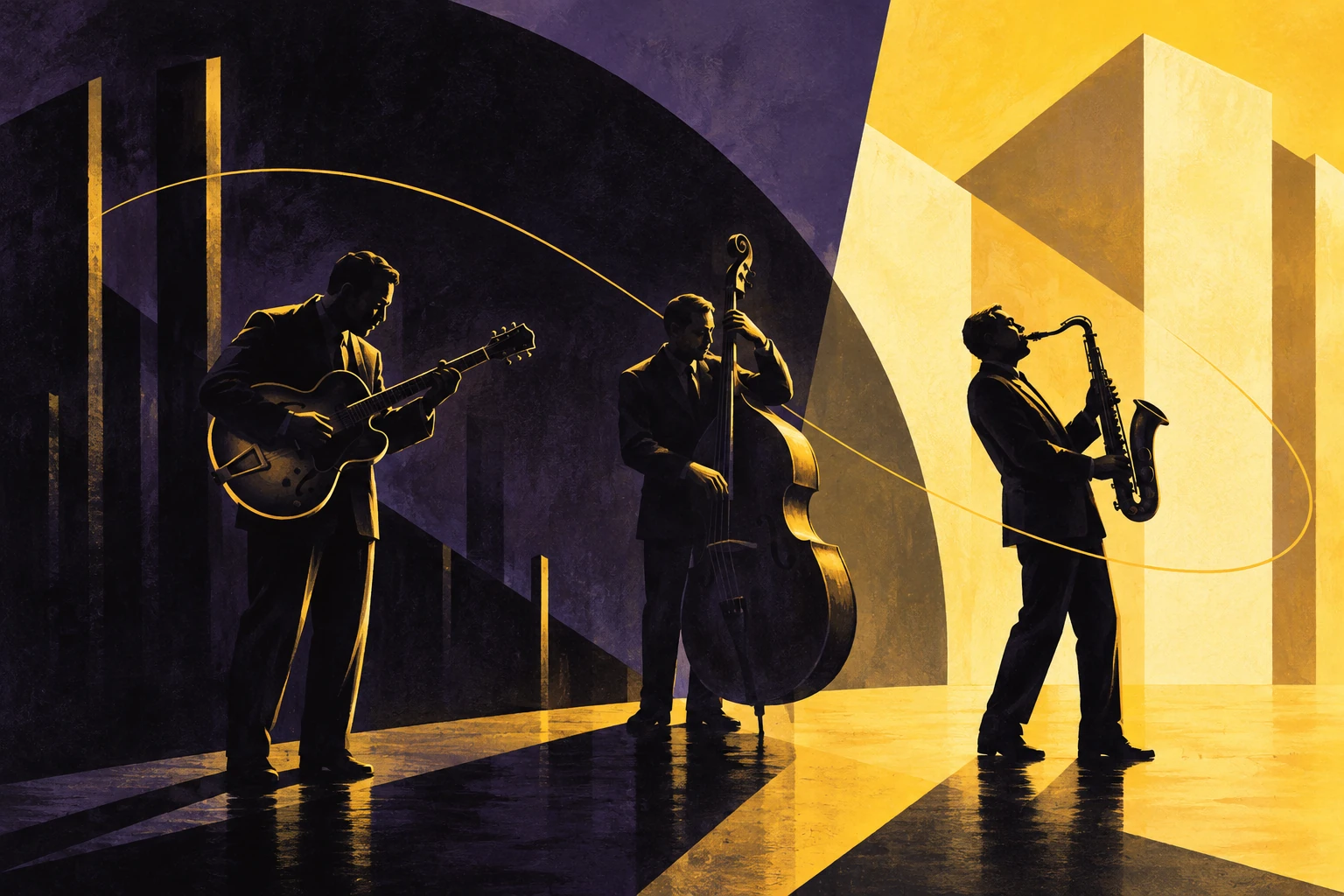
A broad dark arc and a bright angular daylight plane interlock through six loosely spaced modules; one insistent small curved mark persists across both. Day/night contrast and larger chorus architecture define the image without a clock or celestial face.
An original editorial interpretation of the tune. This is an illustration, not an archival photograph or a documented reconstruction of a recording session.
Original Djangopedia illustration · AI-assisted, 2026
Illustration credits & provenance →Selected performances by notable Gypsy Jazz players and ensembles. Inclusion is editorial and does not imply an objective popularity ranking.
The Rosenbergs with Tim Kliphuis · SINTI MUSIC
2021 · TivoliVredenburg, Utrecht; 17 January 2021
Mozes Rosenberg, Johnny Rosenberg and Sani van Mullem credited; violin-led livestream concert.
If playback is unavailable, use the source link.
 Night and Day - The Rosenbergs ft Tim Kliphuis @ TivoliVredenburg Utrecht – Sunday Afternoon Jazz.The Rosenbergs with Tim Kliphuis · SINTI MUSIC2021 · TivoliVredenburg, Utrecht; 17 January 2021Mozes Rosenberg, Johnny Rosenberg and Sani van Mullem credited; violin-led livestream concert.✓ Featured
 JIMMY ROSENBERG NIGHT AND DAY SWING JAZZJimmy Rosenberg · baby bebeJazz manouche / Sinti; source descriptionPerformer identified in title; no date, venue or extra personnel supplied.Select performance
 Sébastien Giniaux "Night and Day"Sébastien Giniaux · keefboof2015 · Atelier Charonne, Paris; 18 March 2015Club guitar performance; accompanying personnel not supplied.Select performance
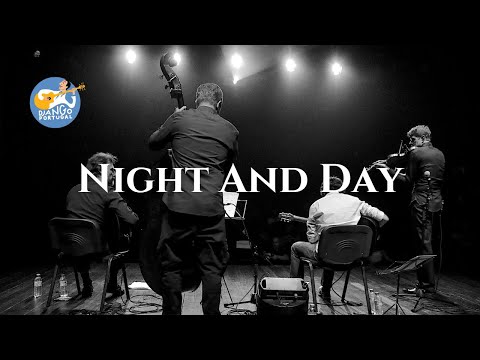 Night And Day - Tim Kliphuis at Festival Django Portugal 2023Tim Kliphuis Quartet · Festival Django Portugal2023 · Festival Django PortugalSource credits Nuno Marinho, Frank Meester and Miguel Falcão.Select performance
 Night and Day | Jonny Hepbir Quintet | UK & International Gypsy Jazz Band HireJonny Hepbir Quintet · Jonny Hepbir Trio2014 · Pangdean Barn; November 2014Vocal ensemble contrast.Select performance
 Night and Day - Gypsy Jazz Trio - Tokyo | JapanRodrigo Santiago, Timothée Aouillé, Kumiko Imakyurei · Rodrigo Santiago2023 · Bar CCO, Shimokitazawa, TokyoTwo guitars and double bass.Select performance
Count six groups of eight bars and play only phrase-ending notes. Then join the endings with short rhythmic ideas without changing the 48-bar count.
Use a steady pulse beneath the insistent melody and connect the descending chords with economical voicings. Keep dramatic accents selective.
Start at 90–110; explore 140–180 bpm
Count six groups of eight bars and play only phrase-ending notes. Then join the endings with short rhythmic ideas without changing the 48-bar count.
Start below the suggested tempo. First hear four quarter-note clicks, then halve the click rate and place clicks on beats 2 and 4. Keep the same phrase length.
Night and Day — D major (legacy chart); 48-bar chorus, six eight-bar phrases. Agree the tempo, pickup, solo order and ending before the count.
Call the concert key and 48-bar form explicitly. Check the selected track’s sounding key before using the inherited D chart.
Use repeated melody notes over restrained moving bass; leave room for the descending harmony to speak.
Call the concert key and 48-bar form explicitly. Check the selected track’s sounding key before using the inherited D chart.
Choose the singer’s comfortable key, then transpose the whole arrangement, including the introduction. Use the original lyric phrasing to shape breathing.
This player guide combines inherited recording evidence and editorial study notes. Musical study notes are editorial suggestions; compare them with the recording.
Composition background and credits ↗
Davide Severino — backing track ↗
Feature photograph — Gypsy Jazz UK historical archive ↗
Original Djangopedia illustration · AI-assisted, 2026
An original editorial interpretation of the tune. This is an illustration, not an archival photograph or a documented reconstruction of a recording session.
Generated with the native image-generation tool on 2026-10-08; original editorial artwork, not a historical photograph.
Prompt: Use case: illustration-story. One original editorial feature illustration for Djangopedia's guide “Night and Day”. Landscape 1536 × 1024, opaque background. Scene: A broad dark arc and a bright angular daylight plane interlock through six loosely spaced modules; one insistent small curved mark persists across both. Day/night contrast and larger chorus architecture define the image without a clock or celestial face. Musical basis from the guide: An insistent melody and a dark approach to a major tonic create a distinctive tension. The 48-bar chorus asks players to hear a larger structure than the familiar AABA template. The supplied chart is D major (legacy chart); form: 48-bar chorus, six eight-bar phrases; feel: Swing. These describe musical inspiration, not visible writing. Historical context: Cole Porter wrote Night and Day for Gay Divorce in 1932. Djangopedia lists Django’s London recording of 31 January 1938 and several later entries. The inherited chart is in D. A backing video labelled for C instruments means concert-pitch notation; that label alone does not establish the tonic key. Do not illustrate disputed historical claims or suggest this imagined scene is an archival session. Medium: noir graphic illustration. Dominant palette: charcoal deep violet and bright yellow. Composition: interlocking day and night fields. Human presence: none. Strong intentional design, clearly drawn/painted, distinctive material marks; keep essential subject safely within the central 70 percent width and middle 80 percent height for card crops. Maintain enough visual substance at thumbnail size. Broad inspiration observed in old photo, ONLY scale/rhythm and never a reference image: three standing figures; lit faces against dark ground. Independently invent every pose, perspective, clothing, setting and lighting. Avoid: No group portrait, sun/moon faces, repeated skyline or numbers. No photorealism, archival simulation, generated text, letters, numbers, labels, fake musical notation, logo, signature, watermark, fake dates, yellowed-paper patina, recognizable artwork or copied photograph. No imitation of any named artist. Render the art edge to edge without borders, mockup or typography. Batch A diversity compensation: avoid blue sky, drifting clouds, cypress trees, moon discs, generic Paris landmarks and curving terrace backdrops unless explicitly essential to the stated scene. Keep this composition tied to its precise stated subject; do not add an unrequested landscape or city. For figure scenes keep the specified standing/walking pose; no seated centered guitar portrait. For abstracts keep purely graphic materials and forms.
Photograph rights are documented separately in its credit. They do not establish the rights status of the composition or recording.